

01/2026
2026-01-14
Poles Increasingly Pessimistic about How the War in Ukraine Will End
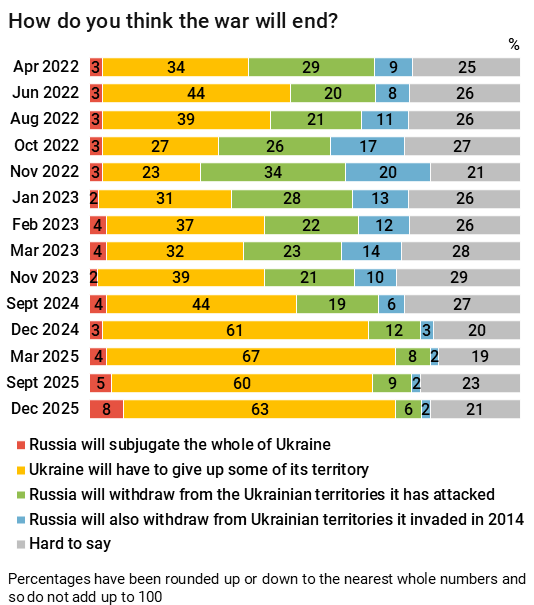
Poles are now even more pessimistic about the war in Ukraine than they were in September 2025, with a majority of the people surveyed taking it for granted that Ukraine will have to give up some of its territory (63%, a rise of 3 points). Most significantly, there has been a marked increase in the percentage of Poles assuming that Russia will subjugate the whole of Ukraine. This has been a marginal opinion since the beginning of the war, usually 2-4% of respondents, but now stands at 8%, a rise of 3 points. Simultaneously, positive prognoses for Ukraine are at an all-time low of 8%, a drop of 3 points, with only 6% of respondents now thinking that Russia will retreat from territories it attacked in 2022, and a miniscule 2% believing this about land invaded in 2014.
|
The dominant view, that Ukraine will have to give up territory, is held more frequently than average by men, people aged 25–44, the better-educated and those considering themselves more well-off. This opinion is mostly independent of worldview and is held by similar percentages of respondents with declared leftwing or right-wing views. It is, however, affected by the respondent’s level of interest in politics: the higher the interest, the more likely is the respondent to assume that Ukraine will have to give up some of its territory. On the other hand, the belief that Russia will subjugate all of Ukraine is particularly widespread among people who say they have little interest in current affairs.
More on this subject in the CBOS report.
This ‘Current Events and Problems’ survey (428) was conducted using a mixed-mode procedure on a representative sample of named adult residents of Poland, randomly selected from the National Identity Number (PESEL) register. Respondents independently selected one of the following methods: Computer Assisted Personal Interview (CAPI); Computer Assisted Telephone Interview (CATI), respondents receiving researchers’ telephone numbers in an introductory letter from CBOS; Computer Assisted Web Interview (CAWI), where respondents filled in the online questionnaire independently, gaining access by means of a login and password provided in an introductory letter from CBOS. In all three cases the questionnaire had the same structure and comprised the same questions. The survey was carried out between 27 November – 8 December 2025 inclusive on a sample of 948 people (62% using the CAPI method, 24.8% CATI and 13.2% CAWI). CBOS has been conducting statutory research using the above procedure since May 2020, stating in each case the percentage of personal, telephone and internet interviews.