
05/2026
2026-02-17
Polish Opinions about the European Union–Mercosur Partnership Agreement
The 17th January this year saw the signing of the European Union–Mercosur Partnership Agreement. Once ratified, it will involve a gradual reduction of import duties on most products and a consequent increase in trade between the countries of the EU and Mercosur. This agreement has elicited farmers’ protests in Europe, with Poland, France, Ireland, Austria and Hungary registering their opposition to it. The European Parliament referred the agreement to the Court of Justice of the EU to check whether it did not contravene any EU treaties.
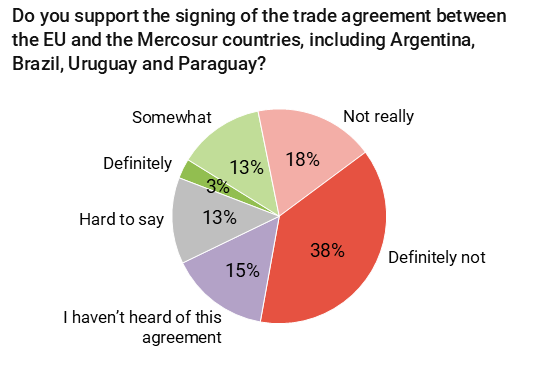
Almost half of the people surveyed were against the EU–Mercosur trade agreement and a mere 16% were in favour. Worth noting is the low number of people (15%) who said they had never heard of it.
|
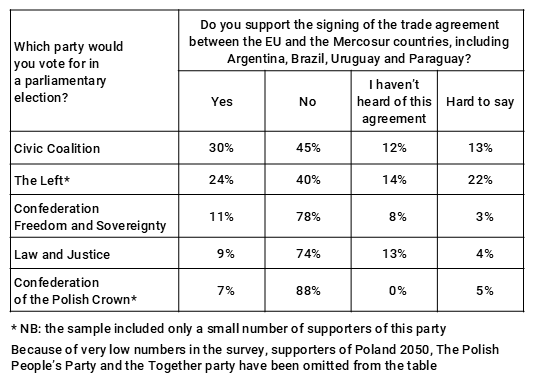
More people oppose than support this agreement in every social-demographic group. Attitudes to it, however, are clearly defined by respondents’ political leanings and the parties they support as a result. The greatest opposition to the EU–Mercosur trade agreement is to be found in the right-wing parties, Grzegorz Braun’s Confederation of the Polish Crown in particular.
|
More on this subject in the CBOS report.
This ‘Current Events and Problems’ survey (429) was conducted using a mixed-mode procedure on a representative sample of named adult residents of Poland, randomly selected from the National Identity Number (PESEL) register. Respondents independently selected one of the following methods: Computer Assisted Personal Interview (CAPI); Computer Assisted Telephone Interview (CATI), respondents receiving researchers’ telephone numbers in an introductory letter from CBOS; Computer Assisted Web Interview (CAWI), where respondents filled in the online questionnaire independently, gaining access by means of a login and password provided in an introductory letter from CBOS. In all three cases the questionnaire had the same structure and comprised the same questions. The survey was carried out between 8 – 20 January 2026 inclusive on a sample of 938 people (55.5% using the CAPI method, 26.4% CATI and 18% CAWI). CBOS has been conducting statutory research using the above procedure since May 2020, stating in each case the percentage of personal, telephone and internet interviews.