
08/2026
2026-03-03
Trust in International Political Leaders
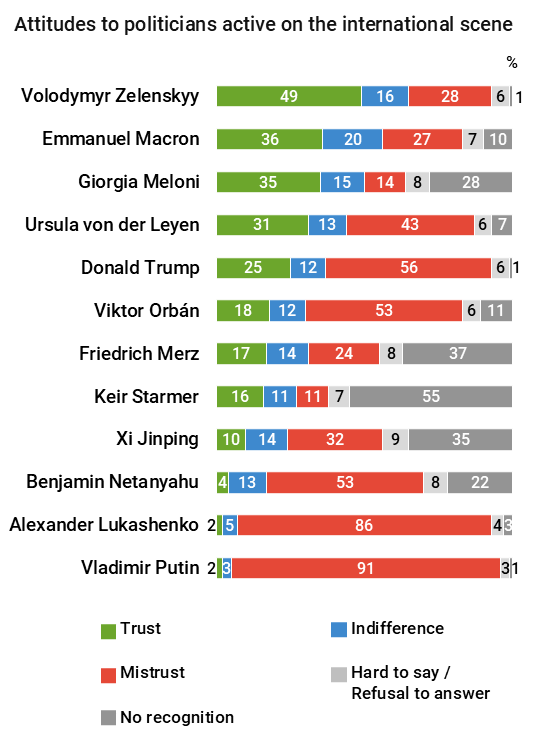
Out of the twelve political leaders included in the CBOS survey only four were considered to be more trustworthy than not. Virtually half of all respondents (49%) – so by far the greatest number – could put their trust in Ukrainian president Volodymyr Zelenskyy, while over one in three could trust Emmanuel Macron (36%) or Giorgia Meloni (35%). However, the French president was also distrusted virtually twice as often as the Italian prime minister (27% and 14% respectively). The fourth leader to elicit more positive than negative reactions was UK prime minister Keir Starmer (16% as against 11%), who was also the least recognisable of the politicians on the list, with 55% of respondents not knowing who he is.
The remainder of the leaders on the list elicited more negative than positive reactions. Without a shadow of doubt, top of the untrustworthy league came Vladimir Putin (91%) followed fairly closely by Alexander Lukashenko (86%). Over half of those surveyed expressed mistrust of Donald Trump (56%), Viktor Orbán (53%) and Benjamin Netanyahu (53%); but while the leaders of the USA and Hungary did attract the trust of some respondents (25% and 18% respectively), the Israeli prime minister was trusted by almost no one (4%).
A lack of trust was also predominant in attitudes to Ursula von der Leyen (43% mistrust against 31% declared trust), Friedrich Merz (24% against 17%) and Xi Jinping (32% against 10%).
|
More on this subject in the CBOS report.
This ‘Current Events and Problems’ survey (430) was conducted using a mixed-mode procedure on a representative sample of named adult residents of Poland, randomly selected from the National Identity Number (PESEL) register. Respondents independently selected one of the following methods: Computer Assisted Personal Interview (CAPI); Computer Assisted Telephone Interview (CATI), respondents receiving researchers’ telephone numbers in an introductory letter from CBOS; Computer Assisted Web Interview (CAWI), where respondents filled in the online questionnaire independently, gaining access by means of a login and password provided in an introductory letter from CBOS. In all three cases the questionnaire had the same structure and comprised the same questions. The survey was carried out between 5 – 16 February 2026 inclusive on a sample of 967 people (60.2% using the CAPI method, 24.1% CATI and 15.7% CAWI). CBOS has been conducting statutory research using the above procedure since May 2020, stating in each case the percentage of personal, telephone and internet interviews.