
28/2025
2025-12-08
Prodemocratic Attitudes in Poland
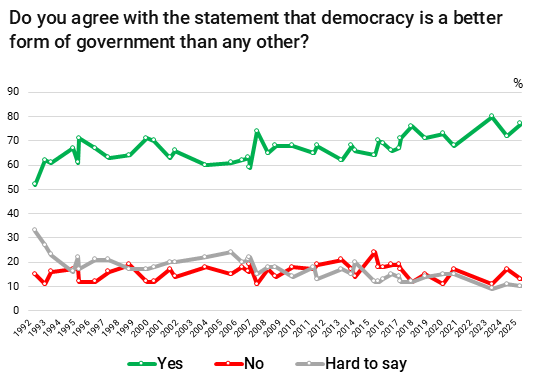
The year 2023 saw a clear rise in the Polish public’s faith in democracy. This was precipitated by the record-breaking turnout for the parliamentary elections that led to a change of government. The following year, however, saw a revision of this enthusiasm. But this year, after a presidential election won by a candidate in opposition to the current government, prodemocratic attitudes have again increased, though not to the 2023 level.
The proportion of people surveyed who agree that democracy is the best possible form of government has risen by five percentage points on last year (from 72% to 77%), while the percentage of those who disagree has dropped four points (from 17% to 13%). Since 1992, when CBOS first started researching this topic, there has always been an unequivocal majority favouring democracy. Moreover, the belief in the superiority of democracy as a form of government is particularly strong now, with only 2023 yielding a slightly higher result directly after the parliamentary elections.
|
Those who thought democracy was better than other forms of government were more likely to be living in larger cities, be better educated, with higher per capita income, more satisfied with their financial position and holding left-wing views.
More on this subject in the CBOS report.
This ‘Current Events and Problems’ survey (426) was conducted using a mixed-mode procedure on a representative sample of named adult residents of Poland, randomly selected from the National Identity Number (PESEL) register. Respondents independently selected one of the following methods: Computer Assisted Personal Interview (CAPI); Computer Assisted Telephone Interview (CATI), respondents receiving researchers’ telephone numbers in an introductory letter from CBOS; Computer Assisted Web Interview (CAWI), where respondents filled in the online questionnaire independently, gaining access by means of a login and password provided in an introductory letter from CBOS. In all three cases the questionnaire had the same structure and comprised the same questions. The survey was carried out between 2–13 October 2025 inclusive on a sample of 901 people (61.2% using the CAPI method, 22.5% CATI and 16.3% CAWI). CBOS has been conducting statutory research using the above procedure since May 2020, stating in each case the percentage of personal, telephone and internet interviews.